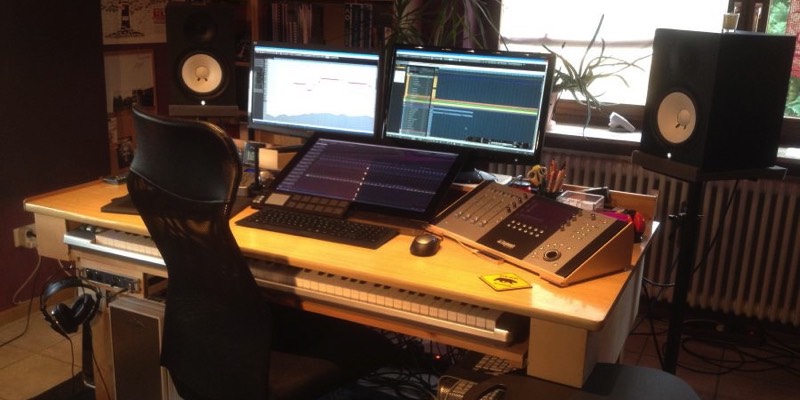
In my personal studio, I work on music in all genres for media productions, specialising on orchestral/electronic hybrid scores as well as concert works. Whenever possible, real instruments are used because the results are just stunning: A single live recorded instrument can inject life into a "canned production“. This tendency has led to a massive library of instruments adorning the shelves around the studio. Everything else comes from an ever-growing array of powerful Virtual Instruments, accessed over network through a custom-fitted orchestral template spread on three machines.
The studio is based around a Cubase/Nuendo rig on a custom PC system with two slaves for hosting Virtual Instruments. All music is composed, recorded and mixed in-house. For exchanging projects with mixing/mastering houses and for easy collaboration, I have a ProTools rig that allows me to work with the industry standard. Using Sibelius, I also engrave scores for recording by session musicians.
I offer every service imaginable, from composing, orchestrating and recording to mixing and mastering the final result and transferring it to you. For Production Music on a budget or tight deadline there is the Novatlan Sound Library, which includes tracks in various styles suitable for trailers, corporate video and many more projects.
Whatever your vision is, I certainly can make it become reality. Challenge me!
What I use
This list is an excerpt of what hard- and software is in use here. If you have any questions, ask via email!

This section shows you some of the technology I use. Click the tabs to jump from section to section. Some things are explained in greater detail when you click on them.
The Signal Flow section has some explanations about the technical setup for anyone interested.
Main DAW
i7 6*3.2 GHz, 64 GB RamAudio Interface: RME Fireface UCX
Hard Disks: 2* 256 GB SSD; 1* 512 GB SSD; 2* 3 TB
NAS / Media Server
Synology 1513+, 15TB, 2 GB RamSynology 201+, 4TB
Audio Interface: M2Tech Hiface (192khz)
Slave 1
i7 4*3.7 Ghz, 64 GB RamHard Disks: 2* 256 GB SSD; 2* 1TB HD
Slave 2
Apple MacPro 2* Quad 2,8 Ghz, 26 GB RamHard Disks: 2* 256 GB SSD; 4* 1 TB
On The Road
Apple MacBook Pro 15' 2.4 Ghz, 16 GB Ram(null)
(null)
Monitors and Headphones
KSdigital ADM25Yamaha HS80M
AKG K271
Input Devices
M-Audio Keystation 88esTEControl USB Breath Controller + Headset
Akai EWI USB
Hardware Controllers
Euphonix MC ControlEvolution UC33E
Korg nanoKEY
Korg nanoPAD
Outboard
Bricasti M7 ReverbRecording
Zoom H6 + APH6 KitZoom SGH6 Shotgun Microphone
Tascam 788
Yamaha MG 10/2
Blue Snowflake
Blue Spark
Oktava MK 012
AudioTechnica AT2020
Sound Modules
Roland Integra-7Wersi OX 7
Sampler
Native Instruments Kontakt 5Steinberg HALion 6
Vienna Instruments Pro 2
Yellowtools Independence Pro 3 REVIEW
Orchestral Instruments
Orchestral Tools Metropolis Ark 1 + 2 + 3VSL Special Edition Full
VSL Special Edition Plus
East West Quantum Leap Symphonic Orchestra Gold
Steinberg HALion Symphonic Orchestra
Quantum Leap Gypsy
Quantum Leap Ra
OrchestralTools Symphonic Sphere
ProjectSAM Symphobia 1 + 2 REVIEW
ProjectSAM Lumina
ProjectSAM Orchestral Essentials
ProjectSAM Symphobia Colours Orchestrator + Animator
Spitfire Albion One
Cinesamples CineOrch
Cinesamples CineSymphony Lite
Strings
Orchestral Tools Berlin StringsOrchestral Tools Berlin Strings Expansion A & B - Special Bows I & II
Orchestral Tools Berlin Strings - First Chairs
Orchestral Tools Berlin Strings EXP E - SFX
Orchestral Tools Nocturne Violin
Orchestral Tools String Runs 2 REVIEW
VSL Solo Strings I Full
Audiobro LA Scoring Strings 2
Cinematic Strings 2
Embertone Friedlander Violin
Embertone Blakus Cello
Dynamic Sound Sampling Orchestral String FX
Dynamic Sound Sampling Orchestral String Arpeggios
Signor Paganini Solo Violin
StrezovSampling Baritone Violin
Cinesamples Tina Guo
Cinesamples CineHarp
Woodwinds
Orchestral Tools Berlin Woodwinds ReviveOrchestral Tools Berlin Woodwinds Expansion A
Orchestral Tools Berlin Woodwinds Expansion B & C - Soloists I & II
Orchestral Tools Berlin Woodwinds Expansion D - SFX
WIVI Woodwinds
Cinesamples Hollywoodwinds
Brass
Orchestral Tools Berlin BrassOrchestral Tools Berlin Brass - Additional Instruments
Orchestral Tools Berlin Brass - Muted Brass
Orchestral Tools Berlin Brass - Horn FX
East West Quantum Leap Hollywood Brass
Cinesamples Cinebrass Core + Pro
ProjectSAM Orchestral Brass Classic
StrezovSampling AMS Trumpets, Horns & Low Brass
WIVI Brass
Choir
Soundiron Requiem LightSoundiron Mercury
Virharmonic Czech Boys Choir
StrezovSampling Storm Choir I + II
StrezovSampling Tropar
Eduardo Tarilonte Cantus
East West Quantum Leap Symphonic Choirs
Rock, Pop & Contemporary
Quantum Leap Fab FourQuantum Leap Ministry of Rock
Sample Logic Fanfare
Fablesounds Broadway Big Band
ProjectSAM Swing
MusicLab RealLPC
Pettinhouse Acoustic Guitar
Wavelore Pedal Steel Guitar
Orange Tree Samples Strawberry Guitar
Orange Tree Samples Cherry Bass
Big Fish Modern Country
Drums & Percussion
Orchestral Tools Berlin PercussionOrchestral Tools Berlin Percussion - The Timpani
Quantum Leap Stormdrum 2
Spitfire Percussion
Spitfire HZ02 - Los Angeles
Spitfire Marimba
Spitfire Crotales
Soundiron Apocalypse Percussion
Soundiron Drum Corps
Cinesamples Deep Percussion Beds REVIEW
Cinesamples CineToms
Cinesamples Randy's Celeste
ProjectSAM TrueStrike 1 + 2
Evolutionseries World Percussion 2.0
Wavesfactory Tubular Bells
Spectrasonics Stylus RMX
Spectrasonics BackBeat Xpander
Spectrasonics Retro Funk Xpander
Spectrasonics Liquid Grooves Xpander
Spectrasonics Burning Grooves Xpander
Spectrasonics Metamorphosis Xpander
Toontrack EZdrummer 2
Steinberg Groove Agent 4
Steven Slate Drums EX
Wavelore Xpan Drums
Soundiron Cymbology Vol. 1
Other
Native Instruments Alicia's KeysOrchestralTools The Orchestral Grands
Cinesamples Piano in Blue
ArtVista Malmsjö Acoustic Grand
Spitfire Orchestral Grand
Spitfire Plucked Piano
Spitfire Enigma
Spitfire Grand Cimbalom
Spitfire Harpsichord
Spitfire Euphone
Spitfire Igneous
Eduardo Tarilonte Era - Medieval Legends II
Indiginus SolidState Symphony
Realitone RealiBanjo
Realitone Acoustic Lite
Realitone RealiWhistle
Impact Soundworks Plectra Series 1 - Bouzouki
Impact Soundworks Plectra Series 2 - Highland Harps
Embertone Chapman Trumpet
Embertone Ivory Wind
Soundiron Acoustic & Electric Saz
Output REV
Output Signal
Spitfire eDNA Earth
WIVI Band
…and hundreds more
Virtual Instruments and other plugins
u-he Zebra 2u-he The Dark Zebra
Spitfire Phobos
Spectrasonics Omnisphere 2
Spectrasonics Bob Moog Tribute Library
Steinberg Dark Planet
Steinberg Granular Guitars
Steinberg Granular Symphonies
Patchpool Sonic Cinema
AAS Lounge Lizard Session
AAS Ultra Analog VA-1
AAS String Studio VS-1
Reverb
Quantum Leap Spaces REVIEWIrcam Flux Verb Session
Eventide UltraReverb
Parallax Audio VirtualSoundStage 2
VSL MIR Pro
VSL MIR Roompack Stages
Mastering
Izotope Ozone 6AOM Invisible Limiter
Steven Slate FG-X
Waves Silver Bundle
Waves AudioTrack
Metering
Flux Pure Analyzer Essential + MeteringEffects
Steven Slate VCCEventide UltraChannel
PSP Nitro
Celemony Melodyne Editor
Antares Duo Evo
Melda Creative Bundle
Metric Halo Channel Strip 3
Metric Halo Charakter
Network
Vienna Ensemble Pro 5 TUTORIALKeyboard Instruments
Korg Kronos 3GB Ram, 90GB SSDTechnics sx-KN6000
Ahlborn CL201
Vogel Upright Piano
String Instruments
The Loar LM-600 MandolinGheorge Ludovicz Violin
Fender Sonoran Acoustic Guitar
Hopf Concert Guitar
Other
Hohner Concerto II AccordionWind Instruments
A. Joseph Al Jo Tin Whistleseveral other Tin Whistles
Jupiter Tenor Saxophone
Percussion
Schlagwerk CP404 Cajontons of percussion instruments!
Fun Stuff
Casio VL-1
About half of the template runs in VE Pro on two slave computers with 64 GB/26 GB RAM. All MIDI and audio data is transmitted via a single ethernet cable, so special hardware, no special software besides VE Pro. Mixing and positioning is done partially inside VE Pro as well as on the PC. This system works really well and can only be recommended.
One Slave PC doubles as a Pro Tools M-Powered rig. For this it has an M-Audio interface connected, which transmits its output via SPDIF to the digital input of the RME Fireface connected to the PC. This allows me to use my studio monitors for Pro Tools as well without having to deal with a complicated monitor controller.
For anyone interesting in building such a system for themselves, please visit OrchestralTemplates.com, where you will find a tutorial as well as setup assistance.
Featured Track
Bio
Born in Frankfurt/Germany, Tobias from his studio works as a composer, orchestrator and arranger for media projects as well as an educator in the field of music technology, notation and music theory. Read more...